
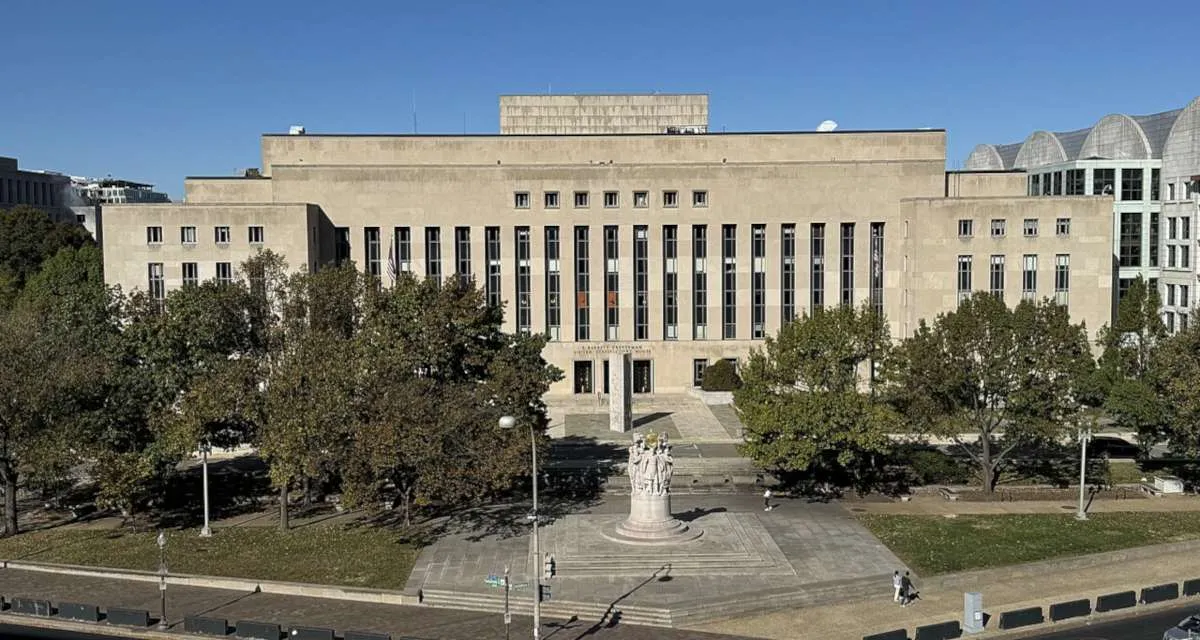
The E. Barrett Prettyman U.S. Courthouse. Photo Credit: Toohool
A federal judge has blocked the FCC’s “early review” of ABC’s broadcast licenses and granted a portion of the Walt Disney Company subsidiary’s preliminary injunction motion.
Judge Loren AliKhan recently rejected the FCC’s dismissal push and approved part of the injunction request, after ABC, its owner, and the relevant stations submitted the First Amendment complaint back in August. Though the filings have been flying in the interim – to the tune of 73 docket entries and counting thus far – the claims themselves are straightforward enough.
“Acting through the Federal Communications Commission, the Administration has waged a retaliatory campaign against ABC for a single reason: it disapproves of what ABC broadcasts,” the plaintiffs wrote in their initial complaint.
This alleged retaliatory campaign, described in the suit as targeting “a network that refuses to bow to the Administration’s demands,” is said to center on the FCC’s April 2026 order for “extraordinarily early” license renewal applications for all eight ABC-owned stations.
And owing to “the threat of non-renewal or revocation of” these licenses, “ABC cannot ignore the consequences of any decision that might anger the Administration or the FCC Chairman,” according to the suit.
ABC therefore claimed it’d made various editorial decisions (such as livestreaming a presidential address that “it ordinarily would not have” shown) due to the license renewal process as well as adjacent regulatory scrutiny aimed at Disney proper.
In the opposite corner, the FCC framed the review as part of its “ordinary investigative processes,” stressed that the licenses would remain active (including during any appeals if they were ultimately denied) throughout, and moved to dismiss on jurisdictional grounds.
Additionally, the agency attributed the early renewal process “to what it perceived as a pattern of evasion in the [March 2025 Disney] antidiscrimination investigation” and as designed to secure “broader access to information in the investigation—just as the Commission’s rules contemplate.”
The “early renewal, unlike the enforcement investigation, is a public process that includes the possibility of an evidentiary hearing,” the FCC added.
This is, of course, a brass-tacks summary of the multifaceted courtroom confrontation. Returning to Judge AliKhan’s order, the court concluded that the plaintiffs “have established jurisdiction over their” First Amendment claim because it “falls far outside the Communications Act’s review scheme” concerning standard regulation violations and more.
Meanwhile, Disney and ABC “have sufficiently cast the early license renewal proceedings as a retaliatory act,” and the “early license renewal proceedings create a risk sufficient to chill a broadcaster of ordinary firmness,” Judge AliKhan wrote.
As such, the court approved a preliminary injunction request enjoining the FCC from continuing the early license renewal proceedings – despite rejecting an injunction motion that would have barred “any actions, formal or informal, to coerce or threaten Plaintiffs with sanctions in an effort to alter their exercise of editorial discretion.”
Regarding where the case goes from here, the litigants now have until December 9th to “file a joint status report proposing next steps in this litigation.” And in a statement, the FCC said it “looks forward to prevailing in full on this matter.”
“While we appreciate the district court denying in part Disney’s request for preliminary injunctive relief, the portion of the decision granting Disney’s motion is wrong on the facts and wrong on the law—as controlling Supreme Court precedent makes clear,” an FCC spokesperson stated. “The FCC looks forward to prevailing in full on this matter. We will continue to use our lawful authority to hold broadcasters accountable to their public interest obligations.”


